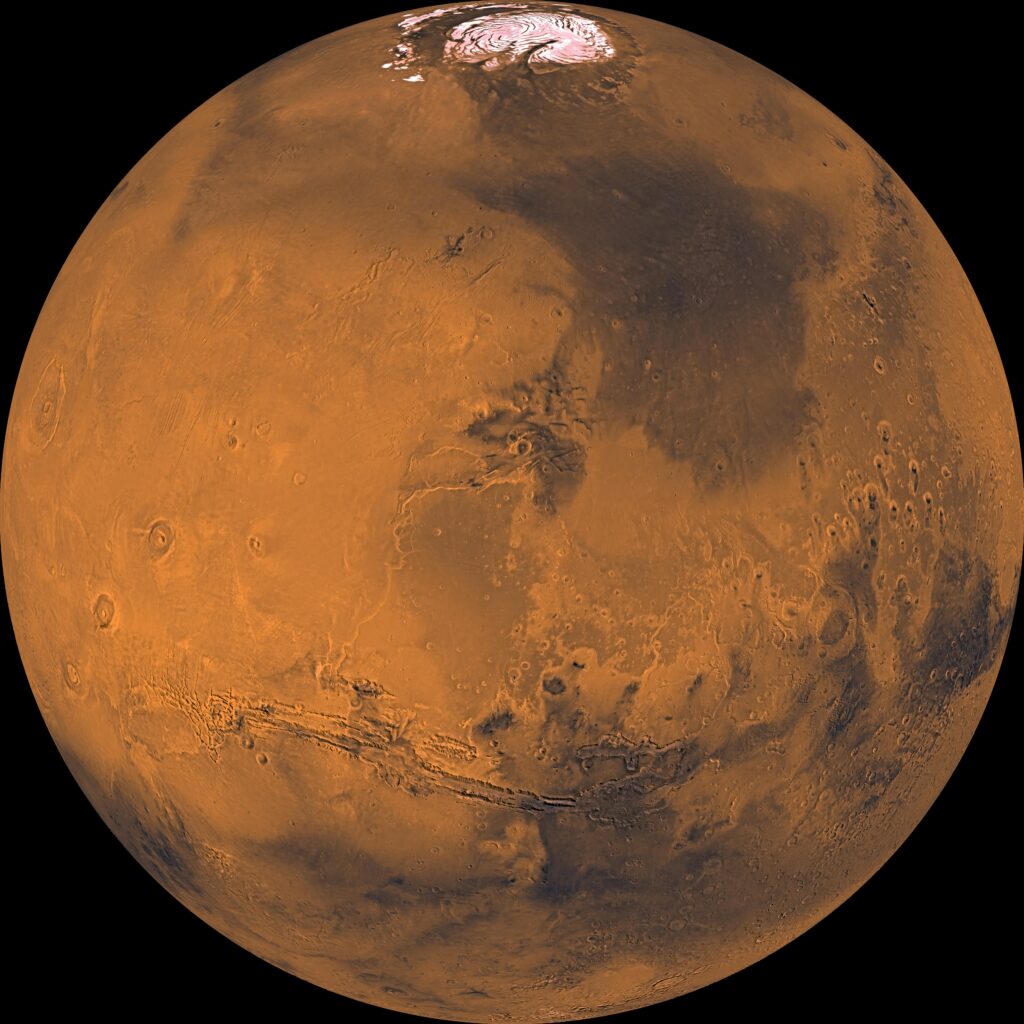

Mars is the 4th planet from the sun, and the last of the inner planets. Mars has a very thin atmosphere, just about 6 thousands of the pressure of Earth’s atmosphere, comprised mostly of Carbon Dioxide. There is some water on Mars, in the soil, in the atmosphere, and in polar ice caps. The surface temperature on Mars ranges from -153o C to 20o C (-243o F to 68o F). Here is some detailed information about Mars. Go here to learn about the terms used in the tables about the planets.
Orbital Information about Mars
| Parameter | Actual Measurement | Scaled to our model |
| Aphelion | 154.9 Million Miles | 4 miles |
| Perihelion | 128.4 Million Miles | 3.3 miles |
| Eccentricity | 0.093 | |
| Sidereal Orbit Period | ~687 earth days | |
| Synodic Orbit Period | ~778 earth days | |
| Ave. Orbital Velocity | 53,837 MPH | 7.35 ft/hr |
| Number of Moons | 2 |
Physical Characteristics of Mars
| Characteristic | Actual Measurement | Scaled to our model |
| Ave. Diameter | 4212 miles (53.3% of Earth) | 6.89 inches |
| Mass | 6.42 x 10²³ kg (10.7% of Earth) | |
| Surface Gravity | 3.72 m/s2 (37.9% of Earth’s) | |
| Sidereal Day | 24 hrs 37 min 23 s | |
| Synodic Day | 24 hrs 39 min 36 s |
Visualizing Mars in our scale model of the solar system
A Dodge Ball
In this model of the solar system, Mars would be about 7″ in diameter, about the size of a regulation dodge ball, which seems fitting for the red planet.

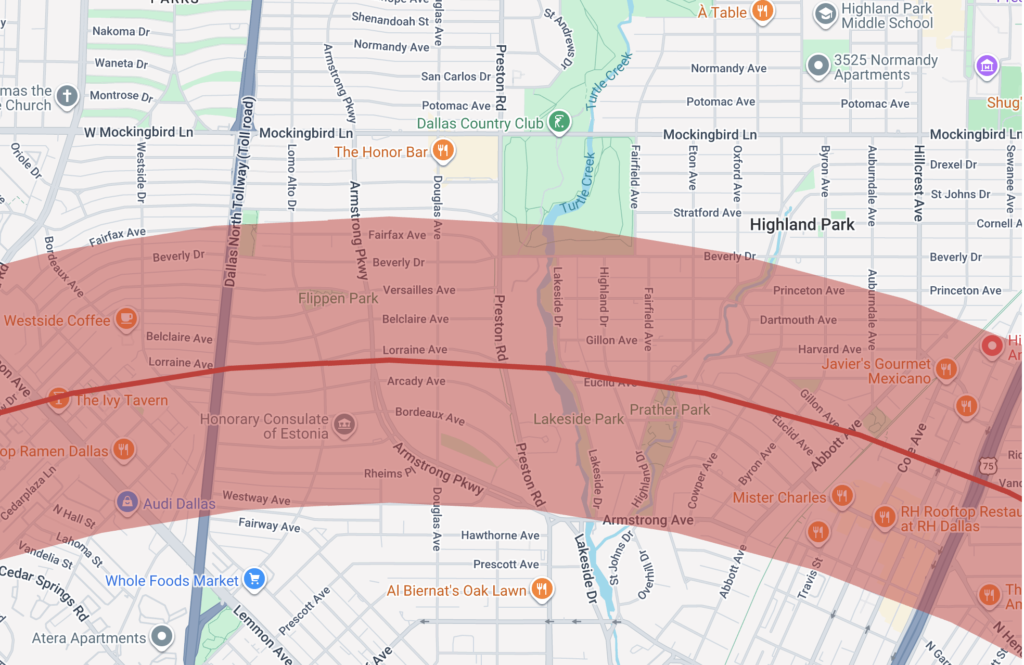
Here is what the orbital path of Mars would look like overlaid north of Dallas. Visit our orbits page to see this on an interactive map.
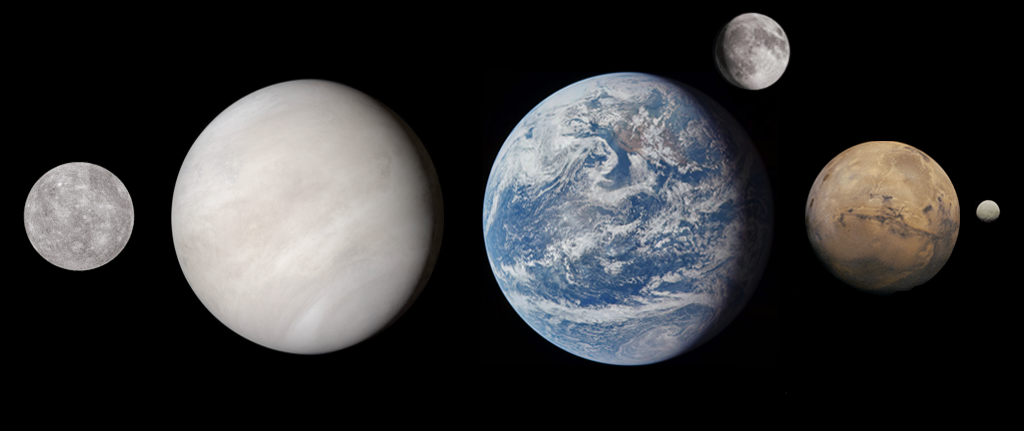
Size comparisons of the inner planets (and Ceres)